Maximizing Profits: How an ROI Equipment Calculator Transforms Your Tree Care Business
Investing in new arborist machinery is a major financial leap for any growing tree service company. Using an ROI equipment calculator ensures every fleet upgrade drives measurable profit and operational efficiency.
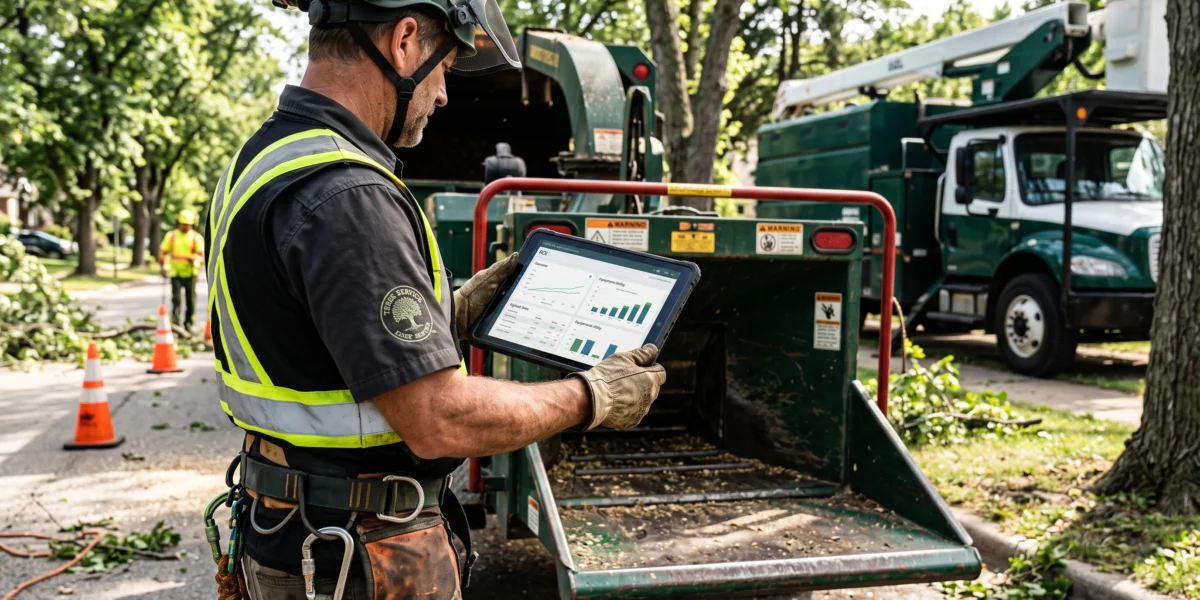
Why Intuition Isn’t Enough for Tree Care Fleet Investments
In the tree care industry, modern equipment isn’t just a luxury—it is the backbone of operational success. Whether you are considering adding a high-capacity wood chipper, a compact track spider lift, or a grapple truck to your fleet, buying commercial machinery represents a massive financial commitment. Historically, many business owners made these capital investment decisions based on gut feel or immediate necessity. However, operating a successful business in 2026 requires a far more strategic approach.
Relying on guesswork can quickly lead to severe cash flow problems, underutilized equipment, or uncomfortably tight profit margins. That is where an ROI equipment calculator becomes an indispensable financial tool. By analyzing capital expenditures against labor efficiency, job capacity, and operational overhead, an equipment ROI calculator gives tree service owners the exact data needed to make confident, growth-driven purchasing decisions.
What is an ROI Equipment Calculator?
An ROI equipment calculator is a financial analysis tool designed to measure the projected Return on Investment (ROI) of purchasing or leasing new machinery. Instead of simply comparing purchase prices, the calculator factors in the comprehensive life-cycle costs of an asset alongside the revenue it will generate.
For tree care business owners, a tailored return on investment tool evaluates critical industry metrics, including:
- Upfront Purchase Price or Financing Terms: Down payments, interest rates, lease payments, and loan durations.
- Labor Cost Reductions: Hours saved per job by substituting manual labor with high-efficiency machinery.
- Increased Revenue Capacity: The additional jobs your crew can complete per week due to faster completion times.
- Ownership & Maintenance Costs: Insurance increases, routine servicing, fuel consumption, and projected repair costs.
- Tax Incentives: Depreciation benefits, such as Section 179 tax deductions.
The Top Financial Benefits of Using an Equipment ROI Calculator
1. Eliminating Capital Expense Guesswork
When you buy a $150,000 spider lift, your immediate thought might be, “How many months of payments can my business afford?” An ROI equipment calculator shifts your perspective to: “How many billable hours will this lift save my crew, and how many extra removal jobs can we book each month?” Quantifying these variables turns a terrifying price tag into a predictable profit engine.
2. Weighing Labor Costs vs. Machinery Investment
The tree care sector continues to face ongoing skilled labor shortages. Hiring, training, and retaining experienced climbers is costly and complex. Upgrading your tree care machinery often allows a three-person crew to perform the work that previously required five workers. An ROI calculator helps you model labor savings directly against machinery financing costs, showing you precisely when the machine pays for itself.
3. Factoring in Total Cost of Ownership (TCO)
The initial sticker price of a tree chipper or stump grinder is only part of the financial equation. Maintenance, commercial fuel costs, hydraulic repairs, wear-and-tear items, and storage all impact your bottom line. A robust ROI equipment calculator incorporates these recurring operational expenses (OpEx) alongside capital expenditures (CapEx) to reveal true profitability.
How to Calculate Machinery ROI: Step-by-Step for Arborists
To run an accurate analysis using an ROI equipment calculator, you must gather reliable data regarding your current production costs and future revenue goals. Follow this framework:
Step 1: Calculate the Total Equipment Cost
Determine the complete acquisition expense. If financing, include down payments, monthly principal, interest, and processing fees. If buying outright, include shipping, taxes, and initial setup charges.
Step 2: Estimate Operational Savings
Calculate how many labor hours the new asset will save. For example, if a modern mini skid steer saves your crew 10 hours per week at an average labor rate of $35 per hour, you save $350 per week—or $18,200 annually—in raw labor costs alone.
Step 3: Estimate Added Revenue Generation
Greater efficiency leads to faster job completions. If faster job site cleanup allows your crew to execute one additional $2,000 tree removal per week, that adds roughly $104,000 in gross annual revenue.
Step 4: Input Data Into the Calculator
Plug these variables into your ROI equipment calculator to calculate two major indicators:
- Payback Period: The exact number of months required for the machine to generate enough net benefit to pay off its purchase cost.
- Net ROI Percentage: The total percentage yield of the investment over a 3- to 5-year timeline.
Real-World Example: Investing in a Spider Lift in 2026
Let’s look at a practical scenario for a growing commercial tree care business considering a $120,000 tracked spider lift in 2026:
- Financed Amount: $120,000 over 60 months at 7% interest ($2,376/month).
- Insurance & Maintenance: ~$400/month.
- Total Monthly Cost: ~$2,776/month.
- Labor Efficiency Gained: Replaces 1 full-time ground position ($4,000/month in wages and benefits).
- Increased Job Capacity: Enables 2 additional medium removals per month ($3,500 extra monthly revenue).
When you enter these realistic metrics into an ROI equipment calculator, the results are clear:
- Net Monthly Value Added: ($4,000 labor savings + $3,500 new revenue) – $2,776 equipment expense = +$4,724 monthly cash flow profit.
- Simple Payback Period: Under 16 months.
Without the math provided by an ROI calculator, the $120,000 price tag might seem like an unjustifiable risk. With the calculations, it is visibly a major profit generator.
Essential Features to Look For in a Tree Equipment ROI Tool
Not all ROI equipment calculators are created equal. When evaluating calculators online or creating your own internal spreadsheet, ensure the tool accounts for:
- Tax Deductions (Section 179): Allows tree care companies to write off the full purchase price of qualifying hardware during the current tax year.
- Resale/Residual Value: High-end arborist equipment retains strong resale value. The calculator should account for equipment equity after 3 to 7 years.
- Seasonal Downtime Adjustments: Tree work fluctuates with weather. Your ROI model should let you input seasonal productivity shifts rather than assuming 12 identical working months.
Take Control of Your Fleet Expansion Today
Scaling a tree service company requires balancing financial risk with operational growth. Investing in commercial tree machinery shouldn’t feel like gambling on your company’s hard-earned capital. By using an ROI equipment calculator, you replace doubt with data, protecting your cash flow while positioning your fleet for maximum long-term profitability in 2026 and beyond.
Operator Insights
Join 2,000+ tree care owners getting our weekly operational tech teardowns.